
Review: ‘Wuthering Heights’ should have gone even further
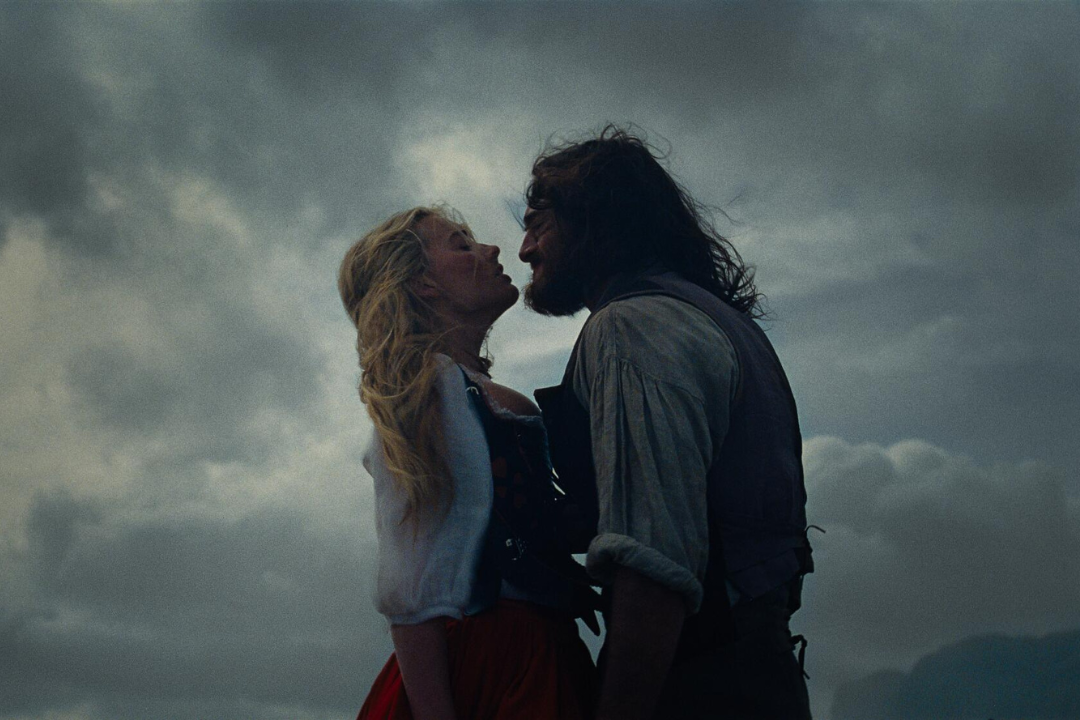
2026 / Dir. Emerald Fennell
Rating: 3.5/5
Watch if you like: reading a trashy romance novel before sitting down to a tasty meal of fish Jell-O and a shrimp-asparagus tower.
Emerald Fennell’s pseudo-adaptation of Wuthering Heights opens with what we imagine is the sound of male pleasure and bed creaking, only to reveal a man asphyxiating to death at the gallows while a bawdy crowd, including a young Cathy Earnshaw (Charlotte Mellington), cheer and party like they’re at Mardi Gras. While not quite reaching the wild peaks of Emerald Fennell’s previous breakthrough, Saltburn, this rush of energy and visual spectacle makes for a very entertaining movie, even if it’s not entirely successful.
Jettisoning characters left and right while keeping the skeleton of Emily Brontë’s original novel—or at least the first half that nearly every adaptation only touches—Fennell fills in with romance novel imagery and a tone that tries to carefully straddle that winking feeling of reading trashy romantic smut that you know isn’t “highbrow” but you can’t help but swoon over. Case in point: when Heathcliff (a never-been-taller Jacob Elordi) decides to take off after overhearing the older Cathy (Margot Robbie) discussing marrying the neighboring Mr. Linton (Shazad Latif), he’s shown astride a horse set against a bright orange sunset in an image that’s pure Fabio.
There are just so many stunningly crafted images, costumes, and sets in Wuthering Heights, both beautiful and bizarre. When Linton shows Cathy to her new bedroom, he’s had it “painted” to look like her flesh—including veins and freckles—in a way that’s straight out of a David Cronenberg movie. Every scene has remarkable details that made me wish I had a pause button in the theater so I could study them—especially the colorfully grotesque dinners that Linton’s staff prepares, which always seem to heavily feature Jell-O abominations.
All of this is in service of an attempted grand romance that doesn’t quite land, even as Robbie and Elordi make for fun scene partners. They work best together in the first half, when Heathcliff and Cathy have a playfully combative rapport, each subtly jockeying for power over the other. Elordi shows a tremendous tenderness reminiscent of Cary Elwes in The Princess Bride, with the camera often pushing in close to his face, allowing him to reveal Heathcliff’s hidden longing and heartache.
It’s in the second half, when Heathcliff returns as a wealthy man and seeks his revenge, that the film loses steam, even as the two characters are allowed to be much more, um, “expressive” in their desire than in most adaptations. That winking tone doesn’t translate to building a Titanic-level romance, and the edit hints at but cuts away from anything that approaches a Saltburn-level of depravity, leaving Wuthering Heights feeling oddly neutered even though it’s still an R-rated film.
The second half is still visually stunning—walls turn red as a reflection of Cathy’s jealousy, for instance—but the pace slows and relies on underwritten characters like Edgar Linton (just a cuckold) and Cathy’s lady maid (why cast Hong Chau and give her nothing to do?). Heathcliff’s turn to a revengeful villain seems like a great fit for Jacob Elordi to pull out his bag of tricks from Euphoria, but even he seems held back from the script that renders him fairly toothless. Likewise, Robbie ends up mainly as a doll, sitting around a pretty house in pretty outfits, as if her Barbie character had fallen victim to the Kens’ rebellion. That said, Alison Oliver (Task, Saltburn) steals every scene she’s in as Edgar’s weirdo sister Isabella, who, in one of Fennell’s best decisions, becomes Heathcliff’s freaky accomplice, rather than usual victim, in his quest to get back at Cathy for abandoning him.
Whether it was worth calling this “Wuthering Heights,” or even “Wuthering Heights” as it’s been stylized, is a fair question, but ultimately I wished Fennell had gone even further with her vision. It’s the visual storytelling, the quirky details, and the vibrant energy that work best in her film and are held back when the script veers too closely into tradition. Still, this is quite an enjoyable movie, balancing broad appeal with a singular viewpoint that should be applauded. I’m certainly excited for whatever Fennell decides to tackle next.