
Review: ‘Avatar: Fire and Ash’ is a stunning yet familiar spectacle
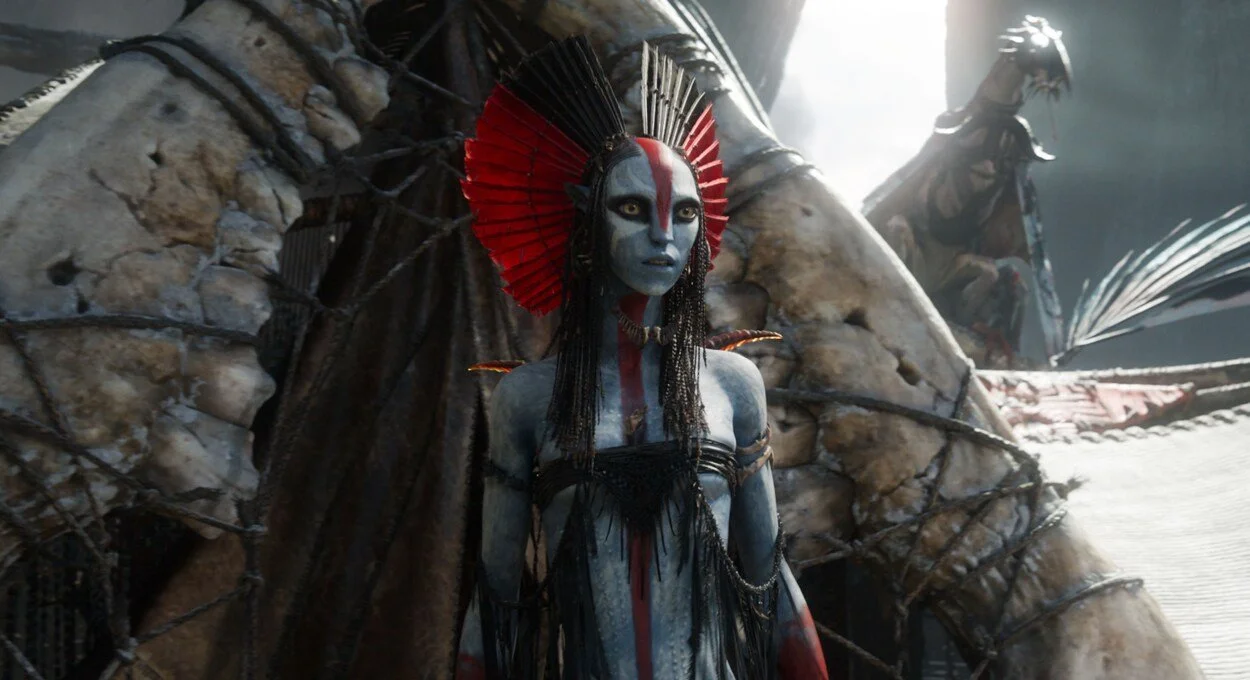
2025 / Dir. James Cameron
☆ 3.5/5
Watch if you like: Avatar: The Way of Water, alien space whale tribunals in subtitled papyrus font, debating whether it’s OK for Varang, the fire witch, to be “mommy.”
James Cameron took advantage of the long gap between the first and second Avatar films by reshaping Avatar: The Way of Water as a soft reboot, with star-crossed, interspecies lovers Jake Sully (Sam Worthington) and Neytiri (Zoe Saldaña) raising their family amid the aquatic Metkayina clan. For anyone like myself who hadn’t revisited the original in that 13-year gap, you could easily get back on board the Avatar train and be immersed in an essentially new world.
Arriving a comparatively short three years later, Avatar: Fire and Ash is a bit of an odd duck for a third movie in a series, acting more as an interquel or B-side to The Way of Water rather than, as the marketing suggests, a new exploration of the fiery Mangkwan clan or significant evolution for the franchise. That leads to many suspiciously similar moments, which can be largely overlooked thanks to the vibrant set pieces and Cameron’s continued effort to combine spectacle with humanity (bluemanity?).
Fire and Ash is grounded in grief following Jake Sully’s loss of his son, Neteyam, at the end of the last film. The family is splintering with undue pressure on the less polished Lo’ak (Britain Dalton) to step up and fill Neteyam’s shoes. Meanwhile, Kiri (Sigourney Weaver, playing a teenage semi-clone of her original character) struggles with her unusual connection to the mystical planet deity Eywa and with her purpose in existence. Then there’s Spider (Jack Champion), the adopted human brother beloved by his siblings and hated by Neytiri, who wants to stay with the Na’avi, but his inability to breathe the planet’s air causes problems for the family and becomes the MacGuffin of the film.
In the first dazzling setpiece of the film, the family decides to take Spider back to the humans on these massive airships driven by these bizarre squid-whale inflatable balloon creatures—I’m all in on just how weird these movies are—that are attacked by our new villains, the Mangkwan, who bring a Mad Max: Fury Road chaos energy to the series. Oona Chaplin is unfortunately underutilized as their leader, Varang, but delivers a captivating performance of witchy sexuality and feral ambition.
Apart from Varang’s crew of marauders, there’s not a lot of new wrinkles this time around. The humans continue to want to poach and destroy all the space whales, while the Na’Avi Avatar clone of Stephen Lang’s Colonel Quaritch continues to pursue the Sully family and resist any character development thrown his way. That said, Quaritch’s partnership with Varang is delightfully strange and results in what might be the first 3D acid trip sequence.
While the human colonizers go through the same motions in each of these movies—and there definitely is too much repetition here—there is something to how empty James Cameron makes these characters that works in his favor. We’re shown people without morals, glued to phone-like devices, who are only interested in consumption. During one of the more fun sequences, a prison break in the human compound, I was struck by these images of humans arriving on a beautiful planet and essentially turning it into an oil refinery. Like all of Cameron’s films, there’s a lot of heart and humanity in them when it comes to families and people trying to get by, but here he is at his most nihilistic.
There is too much déjà vu in this movie, and it doesn’t help that the final hour is spent very much the same way The Way of Water concludes. However, when a movie looks as incredible as Fire and Ash does with constantly entertaining sequences and just a sheer command of every little detail on screen, that’s only a minor ding. I was giddy watching the sheer madness of the final battle sequences and everything happening on screen, even though this story doesn’t take us into truly new territory. Watching these movies makes you feel like a kid again, flinging your toys at each other, and that’s not a bad thing at all.