
Interview: Jeffrey Overstreet on his new movie memoir and finding freedom in faith and fiction

In Maker’s Dozen, we ask folks in and around the film industry 12 questions and have them ask one of us.
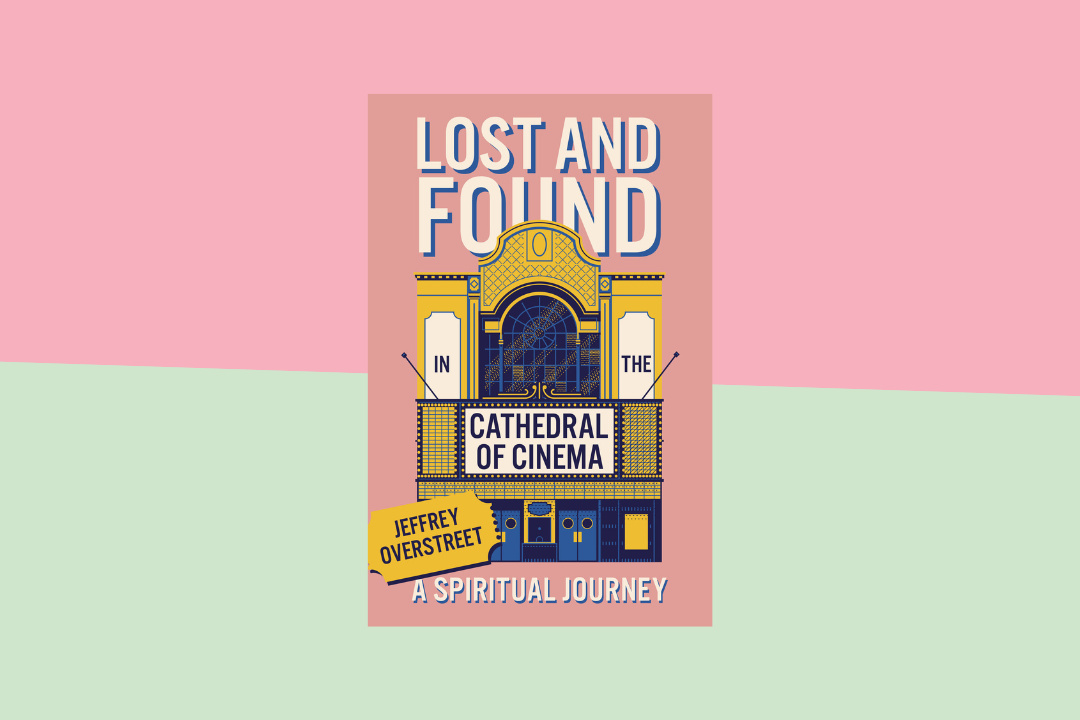
Jeffrey Overstreet is a novelist, creative writing professor, and film critic. Author of the Auralia Thread epic fantasy series and formerly the senior film critic at Christianity Today, his writing on art, faith, and culture has been published at Image, Bright Wall/Dark Room, and Paste among other outlets. He has published two memoirs about cinema and faith: Through a Screen Darkly: Looking Closer at Beauty, Truth and Evil in the Movies (2007) and Lost and Found in the Cathedral of Cinema: A Spiritual Journey, which is available on May 12 wherever you get your books.
In this conversation with Chad Comello, Jeffrey spoke about the new book’s 11-year journey to publication, his evangelical Christian background, his playful writing approach being inspired by Jim Henson, his quintessential Pacific Northwest movie, and much more!
This interview has been edited for content and clarity.
1. What’s the Jeffrey Overstreet origin story?
I grew up in a very conservative Christian community in Portland, Oregon, in the ’70s and ’80s. I attended a small Baptist church community and Portland Christian schools, kindergarten through 12th grade, because my dad taught Bible classes and ran the yearbook program and my uncle taught mathematics and computer science. And while in some aspects I think of that as a kind of bubble I grew up in culturally, I want to be careful because there were so many aspects of that experience in that community that I’m thankful for. I graduated with a small class of about 60, and some of them are still my closest friends today. I moved on to Seattle Pacific University, which seemed like a much bigger world with a much greater focus on faith as an experience of fearlessness and grace rather than withdrawing from the world and focusing entirely on converting the rest of the world to believe what you believe.
What saved me from the harmful aspects of that culture was art, beginning with great Christian artists like J.R.R. Tolkien and C.S. Lewis and some predictable names, but especially Madeleine L’Engle in her book, Walking on Water: Reflections on Faith and Art. That really resonated with me because I so often felt like maybe I was in danger because of the stories that I liked, the movies I was interested in but was told I was not allowed to see, the music I was listening to but was told was corrupting and toxic. I was drawn to beauty. I was drawn to imagination. I was drawn to images and sound, not just a story that arrives as the moral to the story, which always kind of reduced the experience of art to a lesson. Madeline L’Engle spoke so powerfully in the book about beauty as God’s language, truth as God’s language, and God’s language being about more than just lessons. She wrote, “We do not draw people to Christ by telling them how wrong they are and how right we are, but by showing them a light that is so lovely that they will long with all their hearts to know the source of it.” That set me free, not from faith but from the things that were holding faith back: fear, condemnation, cultural separatism, judgmentalism. And it set me free into the worlds of art to be drawn to anything beautiful, anything true, anything worthy of praise. That now is where I think what we call God lives. So I’m grateful to her and to the group we call the Inklings—Tolkien, Lewis, and others—for being bright lights that helped me step out into a bigger world and really start practicing what faith should be. That has enabled me to talk about and celebrate movies with people from all over the world and all different cultures and find out that God is doing a whole lot more out there than we ever imagined in that little bubble I grew up in.
2. Your first movie memoir Through a Screen Darkly was released in 2007. Can you talk about the Jeffrey of 2007 and of 2026, and how your journey between them informed what this new book became?
That book was very much an attempt to justify the ways of art to the people of the community I had grown up in. They had treated art and culture outside of what was being produced within their own circles as something that would contaminate you, seduce you, corrupt you. But as I sort of broke the rules and ran off to see, God forbid, R-rated movies, but also to see movies from other parts of the world and other communities quite different from my own, I started having these profound experiences, and central to those experiences were the conversations that happened after the movie.
I have to give so much credit to my high school English teacher, Michael Demkowicz, who shows up in both of these books and has a whole chapter devoted to him in the new one. He made a practice of inviting students to his classroom and to his home to watch a movie or to listen to an album or to look at visual art and then share our different impressions about them. What I discovered there was when you remove the sort of teacher-class hierarchy and it’s a circle, I was learning from the insights that not just Mr. Demkowicz was sharing but discoveries my classmates were making. I was noticing that a work of art is alive and, if it’s well made, always has more to reveal to you—far more than even the artist imagines. And through those conversations, certain works of art kept calling me back again and again and again.
For this new book, what I’ve done is step away from that sort of argumentative stance and instead just tell stories about the movies that have had the most formative influences on me and the conversations around movies that have helped me see that movies are not an end in themselves, but are a way of learning to live more freely, more fully, with greater attention to my neighbors. And if we are to love our neighbors—which was a pretty central emphasis of the community I grew up in—we’ve got to be able to see our neighbors using our imaginations and being humble enough to believe that they may have aspects of the truth that we haven’t received yet. So each chapter takes a movie or two, and I share my experience of that film as I was growing up or as an adult that helps me look back and understand growing up better. It digs into the conversations I’ve had about the film and what I’ve discovered in those conversations.
3. I love how you play with form in this book, like making your chapter about The Muppet Movie an open letter to Jim Henson. When in the process of writing did you make that choice?
Growing up in the church and thinking of everything in terms of sermons, I was always waiting for how powerfully somebody can deliver a message. And then getting into poetry and starting to develop an appreciation for ambiguity and mystery and the idea that different listeners might arrive at different insights, that helped me recognize that the movies that mean the most to me are movies in which there’s a sense the artist is not here to deliver something to you or to convince you of something, but is inviting you on a journey in which even they are still making discoveries and are excited about it. So I wanted to write in that mode. I wanted to break out of the traditional film review form, which I wrote and published for so many years, and move into more creative, more risk-taking ways of writing about film. Ways that involved being vulnerable and telling some stories from my childhood and my adolescence and even my adulthood that I’m not proud of. Stories where I really woke up to my own prejudice or my own fear or my own arrogance. And that meant messing with the form to see what else was possible.
The Jim Henson letter was just an outpouring of gratitude for him. I was invited to write about a mentor for a journal called Comment, so I chose Jim Henson because I can’t think of an imagination that’s had more influence on me than his. The more I researched him and the more I revisited those formative artistic achievements of his—from Sesame Street to The Muppet Movie to The Dark Crystal—the more I realized his whole endeavor was not only an expression of his faith, which he would then talk about in interviews, but was itself an act of faith, of trying things, of creating a whole bunch of chaos—and I’m going to put air quotes around chaos—to see what meaning emerged. At the same time, he always had particular audiences in mind. He had the vulnerable, the needy, those without privilege. Sesame Street itself was crafted specifically for inner-city black children in order to educate them and give them courage and confidence that they were valuable and that they could contribute meaningfully to the world. And the more I realized that, the more I was like, “No wonder I sensed something here that I didn’t sense in the religious upbringing of my childhood.” So that led to some different playful forms. Play is where I experience what I call God. It’s when you ask a question and you’re fearless about it and you sort of try things and you see what happens. And that powerful question of “What if?” led to some chapters that didn’t end up in the book. Leaps of faith don’t always end well. But it enabled me to discover some vocabularies and ways of investigating experiences with art that I hadn’t seen done before. And on those journeys, I discovered ways to share things that I hadn’t been able to paraphrase before. So I hope that I’m inviting readers into an experience where they discover things of their own and that I then hear from them, because then I’m going to be back learning from them. And that’s what I really want.
4. I appreciated the footnote where you call out all the films you lamented you couldn’t dedicate space to in the book. What was your most painful omission?
I included that because of a lifetime of getting notes from people going, “Why haven’t you written about this?” There’s only so many days in our life, and there are just so many great films. If we’re just talking about movies, much less in the broader world of the arts, the hardest one for me to leave out was an essay I wrote on the Krzysztof Kieślowski film Three Colours: Blue, which I did touch on pretty significantly in Through a Screen Darkly 20 years ago. But like any great work of art, it has continued to speak to me and my appreciation of it now is so much greater than it was 20 years ago. I teach that film every year, and every time I watch it I notice new things. So there’s a 10,000-word essay about it in a book called Film as an Expression of Spirituality: The Arts and Faith Top 100 Films. There was a great online community for many years called Arts and Faith where every few years we would all vote on what we thought were the most spiritually significant films ever made. And Kieślowski’s films often were near the top of that list.
When Blue came out in 1993, it was about the promise of the European Union. The EU was a new thing. The world was filled with hope about all of these cultures and nations that had such bloody histories, trying to work together now as a society, and the harmony that made possible had a lot of people very hopeful about the future. Blue acknowledges the possibility of great harmony and reconciliation, but also challenges us with what that’s going to mean on a personal level when it comes to forgiveness, grieving the past, moving through that grief to something new. It makes love seem as harrowing and as challenging as it really is. I wrote that piece in 2023, and here we are. How do we feel about the EU now? How possible does that seem? So now the film plays much more as a lament, as an outpouring of grief about what we wish we could achieve and what we don’t seem to be capable of on a national level or societal level or personal level. So that chapter for my book would have been a revisiting of that film in that context. Fortunately, I found a home for it elsewhere, because this book just couldn’t stand to be another 10,000 words longer.
5. Of the chapters that do remain, which was the hardest to write and which was the easiest?
Wow, that’s a good question. There are chapters here that took me 11 years to write, like the chapter on Watership Down. Richard Adams’s Watership Down is my favorite novel, but it’s also a movie that has notoriously traumatized generations of children who thought they were sitting down to a cute Disney movie about bunnies and then discovered they were going to get a testimony from a survivor of a world war. That film was very instrumental for me in just growing up. It de-sentimentalized the natural world but also showed me a more beautiful and mysterious natural world than I had understood before. Reading that book at 10 years old, by the way, I don’t advise that for parents unless your child is a very accomplished and discerning reader. But that story taught me how scary the world is, how easily we can persuade ourselves to sort of withdraw into a world of delusion and wish fulfillment and avoidance of conflict, and how necessary it is to learn to get out into the wilderness and make possible an inclusive community of mutual support and generosity and grace if we are ever to arrive in a place where become the kinds of human beings we were meant to be.
I think the centerpiece of the book is the chapter on Wes Anderson’s Moonrise Kingdom. Not to devalue the other chapters, but Moonrise Kingdom for me is really the heart of the book because it shows a community very much like the one I grew up in and what we know today, where the authority figures are living without integrity. The authority figures are saying one thing and doing another, covering up betrayals and scandals, and the young people see this. It’s like that great David Bowie song “Changes” where he sings, “these children that you spit on… they’re quite aware of what they’re going through.” The two children run away not to rebel but to practice what they have been taught—to love one another, to create a sort of Edenic new home on the edge of this island. And in doing so, they enrage the powers that be but ultimately awaken them to their own hypocrisy and damaging effects of their own botched leadership. When I look at that, I see why I had a growing sense of unease and dissatisfaction with the religious circles I was moving in. But I wasn’t turned against what they were teaching. I was aspiring to those things. And that meant I had to break out of that suffocating bubble and engage fearlessly with the larger world. In the Bible I was taught to memorize, the most frequent refrain is “Fear not”. And yet if you ask people around you about the words that characterize evangelical Christians in America today, one of the first words you’re going to hear is fear. Fear and condemnation. So something has gone fundamentally wrong within that culture in America. And faith for me now is about interacting enthusiastically and imaginatively with people from all different cultures all over the world. And I have movies to thank for that.
6. In the chapter about The Black Stallion you write, “I lived in this movie like I have lived in very few since.” What is one of those other movies and what has it been like to live in it?
The Black Stallion is in the book because it gives me a metaphor for discovering the gift of writing, which helped me survive a lot of hardships as a child. It’s also a story of a boy who loses his father in a traumatic situation. As I was loving that movie I was watching my own father go through incredible hardship and depression, so it becomes a chapter about learning to hold on to the source of light, the source of meaningfulness, like the boy and his horse and me and my typewriter. More recently, if I was just to look at some films that have come out in the last year, I feel like I live in the movie Wake Up Dead Man, Rian Johnson’s wonderful, hilarious murder mystery where we get a picture of an extremely fearful church with exclusionary policies that depends on condemning others in order to feel good about itself. And into this community steps a priest whose faith is about having open hands, not closed fists. I see a vocabulary provided for audiences right there that can expose the problems within not just religious communities, but political communities or any kind of identity-based community, as it shows us that you don’t have to abandon the ideals or what is good about that community in order to arrive in a better place. Father Jud does not go in and burn down the church. He restores the church to its fundamental claims of love and forgiveness. So that’s one that just came out last year that I have been living in a lot lately. It so clarifies the mess of things I see every day at the university where I teach or when I’m doomscrolling.
I would also recommend my favorite film of last year, which is a film from Zambia that did not get a lot of promotion in the U.S., called On Becoming a Guinea Fowl. It’s a story about a community there that is under a patriarchal hierarchy that has adopted the vocabulary of Western evangelical Christianity. And it’s a community in which the sexual abuse and harassment of women has been going on for generations and continues being protected by and enabled by the power structures there. The movie is directed by a woman who knows that community intimately, and she gives us a suffering hero who goes back to that community and tries to speak the truth to power. And we end up seeing a reflection of what’s happening right now in our society with the Epstein files. We see the powers that be trying to cover things up, trying to enable and empower abusers, and we see victims being silenced. And that is a recipe for complete societal collapse. This movie shows us that in a microcosm that’s unfamiliar to us, and that kind of experience can help clarify things for us when we’re in the middle of them and can help us see what’s familiar much more starkly in a way that can help us respond more effectively. So On Becoming a Guinea Fowl is the film that has haunted me the most from 2025.
7. The chapter about Do the Right Thing connects how Spike Lee’s movie challenged your limited worldview to your journey of expanding your food palate. What’s a movie you consider an acquired taste, something you maybe didn’t think you’d like but then grew on you?
I think of all the other chapters I wish I could have written, Do the Right Thing made such a difference for me in putting me on the ground in a community quite different from my own that set off lots of alarms for me, because it was a community that I had been conditioned to avoid. Growing up, I would hear about the bad neighborhoods in town. And the more I grew up and the more I ventured out on my own, the more I learned that the bad neighborhoods were the neighborhoods where people were really struggling with poverty, and they were largely black or brown. I definitely saw a diversity of people there that I had never seen in my church or my school. Do the Right Thing made me care and made me feel tensions in the world the way I had been shielded from fielding them before. It also began to help me understand what peaceful protest can look like and how protests can go wrong. And that chapter really, really gets into that.
Right now, I would say that has led me to a love of and so much gratitude for the movies coming out of Iran. And that may sound like a timely political provocation. I do not mean it that way at all. This started many years ago now with the films of Abbas Kiarostami. I would so strongly recommend American communities right now in the church, in academia, in neighborhood basement film clubs or wherever start with a little movie called Where Is the Friend’s House?, which is a simple story about an elementary school classroom where there is a kind of a tyrannical school teacher who terrifies the children. There’s this one little boy who is told that if he doesn’t bring the right notebook to school the next day, he’s going to be thrown out of school. And then our protagonist, this other little boy, makes the long journey home and discovers he has that boy’s notebook. He has that boy’s whole future in his hands. He has got to get that notebook to that child or that child will be thrown out of school by a teacher who doesn’t want to hear any explanations about what went wrong. So we follow this child across town to try to do the right thing. And as we go, we see from the street level what this village looks like, what these people are like, what their struggles are, what a child has to contend with there. It’s one of the most suspenseful movies I have ever seen. And by the end of it, I care about that community so much and understand a little bit of what it is to be a child there. That led me to other Kiarostami films about children and about grown-ups. And because of his courage in truth-telling, which has made him a sort of self-exile of Iran, I now have a richer understanding of that place and that people.
If there is one movie other than Three Colours: Blue I wish I could give a whole chapter to, it’s a film called Timbuktu by the filmmaker Abderrahmane Sissako, which is about what happened in an entirely Muslim community when Islamic extremists came in and established Sharia law and just started doing harm right and left to everyone. You watch this community sort of fragment into different interpretations of the Quran and their own traditions. And I saw there a mirror of the Christian communities I grew up in, how some people take that system and use it to exploit power for their own benefit—and it’s usually men with guns—while others are closer to the heart of the tradition that has something to do with love and harmony and grace and human flourishing. It’s a harrowing film and it’s going to leave you gasping for air. It is not a story with a wish-fulfillment ending. My students often turn around and look at me with rage when the end credits roll because they’re like, “Why did you put us through this and then leave us here?” But the film leaves us with a question and a challenge. What are you going to do about this? Now that we see this playing out in this village, what would you do if you were there? As a matter of fact, you are there or you’re in a place to make a difference. It’s become one of my favorite films. And it’s one of those that has fed and nourished what I believe is real faith in me and helped me start stripping away more and more of those other cultural aspects that prevent me from being fully human. So I’m so thankful for that film. It’s sort of the next-level Do the Right Thing. You should watch those as a double feature if you can possibly bear it.
8. You write very eloquently about the challenges of dedicating time to creative work between your day job, family caretaking, and other responsibilities, which is something I definitely appreciate as the working father of two young boys. How do you reconcile those two parts of your life?
I always feel like where I want to be is just around the corner, and then everything changes. There was a window of time between 2007 and 2011 where I felt like, “OK, this is the life I was aiming for.” This is what I wanted. I’m writing fiction and it’s being published and I’m sharing this fantasy series that I poured 20 years of my life into with a larger audience. Through A Screen Darkly came out and I was able to find a meaningful conversation about my years as a film critic in relationship to the church. Because of what was happening with the books, I was invited to speak. Because of that, people said “You should be teaching.” I said I don’t have a PhD. They said, “Well, you just need a terminal degree in your field. Go get an MFA in creative writing. You work at a university, you have a tuition discount.” So my wife and I did that from 2014 to 2016 with the intention that I would end up teaching. But I was very concerned all along the way. Am I going to be able to write if I’m teaching? Life got more complicated, to say the least. Long story short, in 2016, just as I was starting as an adjunct writing teacher, we discovered that my wife had a very severe brain tumor and was rushed into five and a half hours of life-saving brain surgery and has been recovering from that in the almost 10 years since. She’s doing very well. There are some lingering hardships, but we are just amazed and grateful that she survived and that she’s still writing poetry. She’s still editing other people’s writing. She still maintains her gardening business. But that shook up our lives for several years. COVID came along soon after that. Lots of hardships at the school where I work, just as there are hardships in higher education all across the country right now. I’m in a place now where I have just earned tenure at the university. I have finished this book that’s been 11 years in the making.
I am really hoping I can get back to fiction writing because that is my first love. My response to movies as a child, whether it was The Muppet Movie or Watership Down or Star Wars or The Black Stallion, was that I wanted to be a part of this storytelling thing. That’s where my heart is. Whether that’s going to be possible with the emotional demands, to say nothing of the time demands, involved with teaching creative writing and spending so many hours a day analyzing the creative writing of others remains to be seen, because I tend to invest heavily in my creative writing students. I want them to see big-picture details and I want them to see finer-point copy-editing details. To take on a classroom of 20 students for 10 weeks and then another 20 students for the next 10 weeks is very rewarding. Some of my closest friends are people I’ve met in those classrooms. But when I get home, I don’t really feel like sitting down and looking at a screen full of text. So I am still trying to figure out how to balance those things. The struggle that’s at the heart of that chapter about The Black Stallion continues. And in the last chapter, I chronicle even more of the ups and downs my wife Anne and I have been through in the last 10 years than I’ve talked about here. The world kind of feels like an airplane in turbulence that may be going down sometimes, but maybe that’s the best reason to get back to storytelling. Carlo Collodi, who wrote The Adventures of Pinocchio, was a political activist for many years. And as he got older, he reached a point where he realized that the best thing he could do for the world was to write stories for children that would get them asking the questions they would need to ask to make the world a better place in the future. I’ve been thinking about that a lot lately. There’s a chapter on Pinocchio at the beginning of the book, and I just taught the Pinocchio novel and its various film adaptations to a class. The whole time I was thinking, “He wrote this for children so many years ago in a very different time and place. Maybe it’s more important that I write a story for children right now than yet another movie review.” I don’t have an answer to that yet, but I’m working on it.
“Faith for me is about interacting enthusiastically and imaginatively with people from all different cultures all over the world. And I have movies to thank for that.”
9. You write about making an unexpected connection between My Neighbor Totoro and Oppenheimer that really expands your appreciation for Miyazaki’s masterpiece. I live for those unexpected moments of discovering synchronicity between two works of art, and then trying to tease them out in writing as you’ve done so well. What are some works of art that would make a good unexpected pairing?
Maybe because I’m in the middle of a class right now about text-to-screen adaptations, this is the one that’s springing to mind. Just last week we read a short story called “Saying Goodbye to Yang” by a writer named Alexander Weinstein—no relation to the notorious Weinstein who’s in prison—that’s set in a not-too-distant future where a family has adopted a cyborg child to be a brother to the young girl from China they’ve adopted. This cyborg is programmed to teach his “little sister” about her Chinese heritage, and at the very beginning of the story he breaks down, just like an iPhone might break down. So the story is the father rushing this cyborg child he has purchased around to basically Geek Squad counters trying to get him repaired, and it becomes this wonderful inquiry into: what does it mean to be human? How important is it for us to understand our cultural heritage? And how are we letting devices and technology take the place of actual relationship and actual investment in things that matter? This was made into a beautiful, meditative sci-fi film called After Yang by the great filmmaker Kogonada, who also made Columbus, which is the film that starts out this book. I really recommend that people go and find the story and read that first. But the film starring Colin Farrell and Haley Lu Richardson is extraordinary and expands dramatically on the short story. You could make that a double feature with Spielberg’s A.I.: Artificial Intelligence, with Alex Garland’s Ex Machina, with so many films that are asking us to ponder the risks and the potential of AI, and you will have the stuff of a really powerful conversation.
10. You mention your childhood typewriter a few times in the book, which piqued my interest as a typewriter enthusiast and collector myself. What do you remember about it?
Wow, I’ve never been asked this before. I remember it was heavy. I remember it was shiny and black, and that the keys were those old typewriter keys you’ll find in antique shops with a little glass surface over the figure. I remember replacing and replacing and replacing the ink ribbons. I remember the weight when I would slam the cartridge back at the end of a line, and the sense of accomplishment I would feel every time I would hit it because I was getting closer to the end of another page. I grew up typing with one finger until probably my junior year of high school when I started learning to type with 10 fingers. I’m within reach of a drawer here that is filled with early novels I wrote in elementary school, middle school, high school, that I typed out with my index finger. It felt like there was something at stake. You had to make a physical effort for every letter on that page, and that had to do with something about the pride I felt in finishing a story. It had been a physical endeavor.
I am encouraging my creative writing students, and in some cases in the more advanced classes, to do a lot of physical handwriting, because I think it makes them better writers. I think you have a stronger connection to your imagination when you aren’t on a device that you associate with so many kinds of distraction and interruption. But also I just think there’s a physical link between the head and the hand that is meaningful and that is lost when you surrender so much control to a device. I don’t want to get all theological about it, but the typewriter is a great way to talk about incarnation—what it means when the word becomes flesh, when something that’s a spirit or an idea takes on physical form. That’s what I think about when I think about that typewriter.
11. As a longtime Seattle resident, what’s your quintessential Pacific Northwest movie?
Stand By Me has been back in theaters recently, and there’s something about the spirit of the Pacific Northwest in that. In Through a Screen Darkly I wrote about Don’t Come Knocking, which is a Wim Wenders film that hardly anybody saw that’s set in Butte, Montana, that does wonderful things with the architecture there. But when it comes to actual storytelling about the Pacific Northwest, Train Dreams really stands out. It gets what it feels like to be in the forests of the Pacific Northwest more than any movie I’ve seen. I would put Leave No Trace right up there with that, which takes place just outside of Portland. Almost every critic has compared Train Dreams to Terrence Malick films because of the film’s attention to the natural world and the poetry of it. There is something very right about where the cameras are placed in relation to the trees. You feel the scale of them. I have not watched it on Netflix, so I don’t know how it plays on a small screen. I saw it on a big screen in Port Townsend in a theater called The Starlight Room, which is a special place. I hope people will go and find this place. It’s basically like a ballroom or a banquet room that is filled with antique couches, and there are these wonderful sort of Christmas lights strung around and a chandelier and these amazing curtains that part to reveal the big screen. It’s not a cutting-edge technology theater, but I felt transported with a community into those woods watching Train Dreams there. There’s a lot of Pacific Northwest history in that film, even though it’s not explicit in the screenplay. But if you’re paying attention to what’s happening, the deep conflicts and deep scars of Western expansion and the sort of manifest destiny philosophy that brings with it really toxic racism, that has a lot to do with the broken heart of the man at the center of the film. It’s also a wonderful novella by Denis Johnson that goes into even greater detail about that.
12. What book (besides your own) would you recommend to budding cinephiles?
The books by Matt Zoller Seitz, who is the editor at RogerEbert.com, especially his books on Wes Anderson. There’s a big coffee table book called The Wes Anderson Collection that is really wonderful, and he has continued to put out subsequent volumes to cover films that have come out since that book was published. He actually stepped away to work on another project and Ryan Stevenson and Lauren Wilford, a married couple of amazing critics and artists, stepped up and took over writing the book on Isle of Dogs. That is not my favorite Wes Anderson film by any stretch, but they turned that book into a film school. You learn so much, not just about the puppetry involved in that film but the storytelling, the many different influences, and the heavy influence of Kurosawa films on Isle of Dogs. That’s a great book. I’m also a big fan of Josh Larsen, the co-host of Filmspotting. His book Movies Are Prayers feels to me sort of like a spiritual neighbor to Through a Screen Darkly. I’m very grateful for that book, and I use that book in my classes. Those are a few books that I point people to frequently.
My friend Sean Gaffney, who was responsible for writing some of the early and best VeggieTales stuff, has a new book out about the art of story called Meta Story. I haven’t seen it on many bookshelves yet, but knowing him and his wisdom on the art of storytelling, I cannot wait to get my hands on a copy of that. Joel Mayward, who teaches film classes at George Fox University down near Portland, Oregon, has a new book called Theology and the Films of Christopher Nolan: Cinematic Transcendence, which is a deep dive into the Christopher Nolan films that you love and the ones you haven’t seen yet. I also want to mention Sarah Welch-Larson has a remarkable book on the theology of the Alien franchise called Becoming Alien: The Beginning and End of Evil in Science Fiction’s Most Idiosyncratic Film Franchise, and she’s just put out an updated version of that because we keep getting more Alien movies. That’s an incredible work of research and reflection.
+1. What’s your question for me?
Cinema Sugar casts its net very widely, and I’m impressed with the variety of people you’ve interviewed. And somehow you manage to stay on top of a lot of current films. What have you discovered in your recent moviegoing and your recent conversations with other moviegoers that gives you any sense of where we’re headed? Theaters are closing all around me. At the same time, I would say I feel this sort of equal and opposite surge of interest in the communal experience of cinema. People are losing patience with watching movies on their phones. I wonder if you’re picking up on any trends, anything promising for moviegoers or do you see the end coming?
Chad: Man, that’s a big thing. We’re very lucky to have our chief critic, James Podrasky, who’s able to see and review a lot of new movies coming out in theaters. But even beyond that, I wouldn’t go so far as to say I’m anti-streaming or can’t stand it anymore. I certainly understand why people would be, but I’ve always been pretty agnostic about where a movie is coming from, whether it’s streaming or in theaters. As much as I absolutely love going to a theater, to me it’s the movie itself that is most important. Seeing a movie like Train Dreams completely knocked me out even though it was on Netflix. In terms of the future of movies, it’s hard with all these corporate mergers and theaters closing—you kind of feel helpless as a single consumer and just kind of hope for the best. But the art form itself is going to survive. There’s always going to be movies to watch, and I’m always going to be grateful for being able to watch them.